And if you're already in the market for a game with a lot of procedural generation, I heartily recommend FTL. Not really horror, but lots of accidental suffocation. Remember to close your airlocks, people.
Friday, March 8, 2013
Darkwood Pre-Alpha
Procedural generation seems like a natural fit for a genre that depends on the element of... SURPRISE *cough* Anyway this indy-horror Darkwood game looks very promising. (Don't trust the creepy ghost-child. Pianists are sketchy.)
And if you're already in the market for a game with a lot of procedural generation, I heartily recommend FTL. Not really horror, but lots of accidental suffocation. Remember to close your airlocks, people.
And if you're already in the market for a game with a lot of procedural generation, I heartily recommend FTL. Not really horror, but lots of accidental suffocation. Remember to close your airlocks, people.

Wednesday, February 27, 2013
The Power of Implicit Goals
This is an addendum to my post a while back about explicit vs implicit goals. I've been thinking more about the issue, and it strikes me that not recognizing the validity of implicit goals can have a deleterious effect on various aspects of game design.
It's natural to think in terms of explicit goals where players have to complete a particular task like dodging the fireballs or finding the key in order to succeed. The problem with explicit goals is that there is definitionally some possibility for failure built into the game. Maybe the player can't find the key or manage to dodge correctly and the narrative grinds to a screeching halt because they are unable to proceed.
As a brilliant example of an implicit goal, I submit the tutorial for Eternal Darkness: Sanity's Requiem. The game is genius in many regards, but I find the initial introduction particularly genius. Shortly after selecting “New Game,” the player finds themselves trapped in a room with an endlessly spawning horde of emaciated zombie-like creatures and armed with a shotgun. The player then discovers how to aim and discharge said shotgun into the mob for a short while until they awaken in a cold sweat to discover the combat tutorial was a dream all along!
This sequence is brilliant in terms of pacing in that it immediately grabs the player's attention for the following expository cutscene, rather than like most games where the player would impatiently sit through this cutscene waiting to be allowed to kill something. (It also does a good job of immediately humanizing the protagonist, which is also something a great many games struggle with.)
But what is pertinent here is the fact that shooting the zombies is a wholly implicit goal. There is no health bar introduced yet. It does not matter how effectively one deals with the zombies. The player could get completely mobbed by them, or she could dispatch them with ease and efficiency. But it doesn't matter. Mechanically speaking there are zero stakes; the heroine awakens in a cold sweat regardless. And furthermore it doesn't matter that it doesn't matter. The player isn't thinking “I don't see a health bar so I'll just let the zombies maul me,” she's thinking “Ahh! Zombies! Get away! Take that!”
Were there no consequences to zombie-mauling for the entire game, it would quickly lose its horror-aesthetics and feeling of challenge. But the purpose of the tutorial is not to provide challenge, it is to put across the basic mechanics in a way that also serves the narrative flow. (Also no player is going to replay the tutorial and be annoyed that they can't lose, because at some level they recognize what the tutorial's purposes are and aren't.)
Another example of this idea is the indie game Dys4ia, which attempts to put across the designer's experience of going through a sex change procedure via a series of often-abstract minigames which serve to convey various emotional circumstances. While there are some points at which an action must be performed by the player in order to proceed (making them explicit goals imposed by the mechanics), in each of these cases the action is both easy and glaringly obvious (e.g. press "up"). In any minigame in which there is actually some challenge posed, such as when the player deflects hurtful comments with their shield, there is not actually any penalty for failing to do so. Perhaps this is because we are all ingrained with games like Pong (which at one point maybe did require its failure penalties to teach the correct play dynamics), but it in no way detracts from the intended experience that the player cannot fail, and in fact having to retry a minigame would completely ruin the artistic message. The game isn't trying to tell you "if someone's comments hurt you, just keep listening to them over and over until you are able to deal with it." (Of course the unintended message of most games is "if you fail to defeat this world-ending threat, don't worry, you can just keep trying until you inevitably succeed," but that's another discussion.)
The point is that player behavior is guided by more than explicit goals, and additionally having an explicit goal can actually ruin the intended experience. Would it be a good experience for the player to fail the tutorial in Eternal Darkness and have to try again? No! It would be annoying, feel "gamey" and also vastly reduce the menace of the zombies when they are reintroduced much later. Luckily there is no need to make failure a possibility in this case because the player will behave as intended regardless, and the sequence loses no excitement or impact.
If we assume that players' behavior is guided only by what is mechanically defined as success and failure, we hamstring our ability to craft certain experiences. For example, escort missions are almost universally hated in games. This is because the goals of these sequence tend to be too explicit in the sense that if the character is not escorted properly, the player fails the sequence and is forced to go back and try again. On the opposite end is Telltale's The Walking Dead game (which in my opinion is one of the best games ever made) containing a couple of sequences in which you are trying to "protect" a character, but where failure is actually impossible (in one, you cannot make it to them in time, but another character steps in). These sequences work because it is unclear when the player is in danger of being penalized for failure, as well as being unclear what the ramifications will be (sometimes it means trying again, sometimes it means a beloved character is permanently dead). Secretly mixing between these three types of sequences (ones where you can't fail or it's almost impossible to fail, ones where you can try again, and ones where the effects of your actions are permanent) allows the game to ambiguate player assumptions in order to craft an experience (or rather, a set of possible experiences) which successfully puts across the intended emotions.
We can argue about whether The Walking Dead is really a game or an interactive story (it's both, and to varying degrees all games are also interactive stories), but the answer is irrelevant. What matters is that, through a combination of story and mechanics, The Walking Dead is successfully putting across unique emotions and experiences that no other game has managed, and so is Dys4ia, and they are doing so by subtly challenging longstanding conventions about how games, and gamers, work.
It's natural to think in terms of explicit goals where players have to complete a particular task like dodging the fireballs or finding the key in order to succeed. The problem with explicit goals is that there is definitionally some possibility for failure built into the game. Maybe the player can't find the key or manage to dodge correctly and the narrative grinds to a screeching halt because they are unable to proceed.
As a brilliant example of an implicit goal, I submit the tutorial for Eternal Darkness: Sanity's Requiem. The game is genius in many regards, but I find the initial introduction particularly genius. Shortly after selecting “New Game,” the player finds themselves trapped in a room with an endlessly spawning horde of emaciated zombie-like creatures and armed with a shotgun. The player then discovers how to aim and discharge said shotgun into the mob for a short while until they awaken in a cold sweat to discover the combat tutorial was a dream all along!
This sequence is brilliant in terms of pacing in that it immediately grabs the player's attention for the following expository cutscene, rather than like most games where the player would impatiently sit through this cutscene waiting to be allowed to kill something. (It also does a good job of immediately humanizing the protagonist, which is also something a great many games struggle with.)
But what is pertinent here is the fact that shooting the zombies is a wholly implicit goal. There is no health bar introduced yet. It does not matter how effectively one deals with the zombies. The player could get completely mobbed by them, or she could dispatch them with ease and efficiency. But it doesn't matter. Mechanically speaking there are zero stakes; the heroine awakens in a cold sweat regardless. And furthermore it doesn't matter that it doesn't matter. The player isn't thinking “I don't see a health bar so I'll just let the zombies maul me,” she's thinking “Ahh! Zombies! Get away! Take that!”
Were there no consequences to zombie-mauling for the entire game, it would quickly lose its horror-aesthetics and feeling of challenge. But the purpose of the tutorial is not to provide challenge, it is to put across the basic mechanics in a way that also serves the narrative flow. (Also no player is going to replay the tutorial and be annoyed that they can't lose, because at some level they recognize what the tutorial's purposes are and aren't.)
Another example of this idea is the indie game Dys4ia, which attempts to put across the designer's experience of going through a sex change procedure via a series of often-abstract minigames which serve to convey various emotional circumstances. While there are some points at which an action must be performed by the player in order to proceed (making them explicit goals imposed by the mechanics), in each of these cases the action is both easy and glaringly obvious (e.g. press "up"). In any minigame in which there is actually some challenge posed, such as when the player deflects hurtful comments with their shield, there is not actually any penalty for failing to do so. Perhaps this is because we are all ingrained with games like Pong (which at one point maybe did require its failure penalties to teach the correct play dynamics), but it in no way detracts from the intended experience that the player cannot fail, and in fact having to retry a minigame would completely ruin the artistic message. The game isn't trying to tell you "if someone's comments hurt you, just keep listening to them over and over until you are able to deal with it." (Of course the unintended message of most games is "if you fail to defeat this world-ending threat, don't worry, you can just keep trying until you inevitably succeed," but that's another discussion.)
The point is that player behavior is guided by more than explicit goals, and additionally having an explicit goal can actually ruin the intended experience. Would it be a good experience for the player to fail the tutorial in Eternal Darkness and have to try again? No! It would be annoying, feel "gamey" and also vastly reduce the menace of the zombies when they are reintroduced much later. Luckily there is no need to make failure a possibility in this case because the player will behave as intended regardless, and the sequence loses no excitement or impact.
If we assume that players' behavior is guided only by what is mechanically defined as success and failure, we hamstring our ability to craft certain experiences. For example, escort missions are almost universally hated in games. This is because the goals of these sequence tend to be too explicit in the sense that if the character is not escorted properly, the player fails the sequence and is forced to go back and try again. On the opposite end is Telltale's The Walking Dead game (which in my opinion is one of the best games ever made) containing a couple of sequences in which you are trying to "protect" a character, but where failure is actually impossible (in one, you cannot make it to them in time, but another character steps in). These sequences work because it is unclear when the player is in danger of being penalized for failure, as well as being unclear what the ramifications will be (sometimes it means trying again, sometimes it means a beloved character is permanently dead). Secretly mixing between these three types of sequences (ones where you can't fail or it's almost impossible to fail, ones where you can try again, and ones where the effects of your actions are permanent) allows the game to ambiguate player assumptions in order to craft an experience (or rather, a set of possible experiences) which successfully puts across the intended emotions.
We can argue about whether The Walking Dead is really a game or an interactive story (it's both, and to varying degrees all games are also interactive stories), but the answer is irrelevant. What matters is that, through a combination of story and mechanics, The Walking Dead is successfully putting across unique emotions and experiences that no other game has managed, and so is Dys4ia, and they are doing so by subtly challenging longstanding conventions about how games, and gamers, work.
Monday, February 25, 2013
48 Hour Global Game Jam
So there's this little thing called the 48 Hour Game Jam that I participated in last month for the first time, figured maybe I should give my impressions.
Basically it was awesome. I met a bunch of great people, sang along to The Final Countdown several times, and just generally had a blast being in such a productive climate. I helped brainstorm some ideas and offered feedback here or there, worked out some basic for a trick-taking card game with my good friend Tom Sarsons, and composed the music for two games: Pump up the Jam and Bullet Cell (links over there ---->).
I guess what I'm saying is, if you're interested in any aspect of videogame production, this is absolutely an experience I'd recommend.
Last year GGJ won the Guinness World Record for largest "game jam," and from what I heard it was even bigger this year, but I'm not sure whether 2013 set a new record, so I may or may not have helped set a Guinness World Record, but I will still aid in the production of any novelty oversize foodstuffs just to be safe.
Basically it was awesome. I met a bunch of great people, sang along to The Final Countdown several times, and just generally had a blast being in such a productive climate. I helped brainstorm some ideas and offered feedback here or there, worked out some basic for a trick-taking card game with my good friend Tom Sarsons, and composed the music for two games: Pump up the Jam and Bullet Cell (links over there ---->).
I guess what I'm saying is, if you're interested in any aspect of videogame production, this is absolutely an experience I'd recommend.
Last year GGJ won the Guinness World Record for largest "game jam," and from what I heard it was even bigger this year, but I'm not sure whether 2013 set a new record, so I may or may not have helped set a Guinness World Record, but I will still aid in the production of any novelty oversize foodstuffs just to be safe.
Saturday, February 16, 2013
Surrogates Review: Determinedly Pointless
I saw the Bruce Willis movie Surrogates
a while back and it frustrated me. Enough so that I intended to write
a post on it, but doing so has taken me several months because I
wanted to gather my thoughts it was sort of unmemorable and
I forgot about it.
Surrogates is the most frustrating type
of movie because it is not straightforwardly bad such that one can
simply mock it or discard it, rather it is quite watchable and
competently constructed, yet falls drastically short of what it might
have been. This is mostly because Surrogates has quite a strong
and socially relevant premise.
The idea is that it's “the future”
and humans, rather than living normal lives in our flawed
meat-bodies, have adopted perfect android bodies as “surrogates”
(title drop!) through which they experience and interact with the
world from a neural interface at home. Not only is it more fun to be a physically perfect meta-human, but it also makes life a whole
lot safer when anything bad that happens to your surrogate can be
solved by, worst case, going out and buying another one. However, FBI
agent Bruce Willis discovers the existence of a weapon which has the
ability, when a surrogate is shot with it, to overload its system in
a way that kills the real-life person operating it.
This all sounds dandy until one
realizes that the last bit completely undoes everything about the
premise of the film. What makes the world of Surrogates intriguing is
the idea that one could live as an immortal avatar of one's self,
which could have interesting ramifications for an action thriller of
this sort. For example, how can you stop a terrorist who cannot die?
To what lengths might someone go when they are in no physical danger?
And how does the average hooligan behave when their actions can't
physically harm others or be effectively traced back to them?(see:
The Internet) None of these ideas are properly explored because the
plot's central devise precisely nullifies all of the potential of its
premise, and we are left with a standard action film in which people
are shot and then die as a result.
On top of this, the film has one of the
dumbest moments I've ever seen. Bruce Willis discovers that his boss
might have been working with the bad guys all along (as one does in
these sort of movies), so he wanders into FBI headquarters after
getting suspended (as one does in these sort of movies), gets his
boss alone in his office, and proceeds to stab him (or rather, his
surrogate) in the back of the head so he can paw through his computer
and transfer some incriminating files to a USB. After the download
completes, he causally walks back into the main area just as one of
his co-workers receives a call from an angry boss complaining about a
stabbing incident and suggesting rather vocally that perhaps someone
should stop our hero from leaving the premises. Then we cut to him
driving away. Wait, what?
It's been clearly established
previously that when harm comes to a surrogate, the user is instantly
booted back to reality, and the boss is shown to still be sitting in
his neural interface chair while he makes the call. This means that
in order for the scene to play out the way it does, the boss finds
himself at home having been “murdered,” then decides to wait a
while and give our hero a fair chance, or maybe hunt around behind
couch cushions to find his fairly large phone and then go back and sit in his neural interface chair, and then make the call. Meanwhile our
hero casually walks through an office building full of employees who
have just been informed that he killed their boss and should be
immediately detained. No reason to show how that played out, just cut
to him driving away. No, it's fine, no need for an action movie to
show how its hero escaped from what appeared to be an inescapable
situation. This is one of the few instances where showing our hero jump out a plate glass window or single-handedly fight off a bunch of trained FBI agents actually would have made more logical sense.
Aside from the largely wasted premise and some sprinkles of idiocy, Surrogates is actually decent. It mostly fails as an "ideas" movie, but as a straight action thriller it's moderately engaging, and it does at least get some mileage out of the concept that one doesn't know precisely who one is talking to when interacting with a surrogate. For example, this review was actually written by Ron Perlman.
Aside from the largely wasted premise and some sprinkles of idiocy, Surrogates is actually decent. It mostly fails as an "ideas" movie, but as a straight action thriller it's moderately engaging, and it does at least get some mileage out of the concept that one doesn't know precisely who one is talking to when interacting with a surrogate. For example, this review was actually written by Ron Perlman.
Tuesday, February 12, 2013
The Resource Economy of Super Mario Bros.
It is my contention that virtually any game can be better understood by viewing it as a resource economy and determining what the resource conversions are. To illustrate this, I've drawn up a (perhaps not exhaustive) resource economy for the original Super Mario Bros. and labeled the less-obvious conversion methods.


Friday, February 8, 2013
Fan Film Fanfare: Super Mario Busters & History of the Soviet Union Arranged To The Melody Of Tetris
Videogame-related fan film production quality has become ridiculous lately (and I'm not even speaking of Freddie Wong).
Sunday, January 20, 2013
Tesla's Revenge Soundtrack
I am pleased to publicly announce my upcoming game Tesla's Revenge soon to be released on iPhone, iPad and iPod Touch! I'm proud to be the first indy title of Codito Development, makers of the iPhone versions of several illustrious boardgames including Tigris & Euphrates, Tikal, Ra and Puerto Rico.
Maybe "soon" is a strong word. I'm still in the thick of designing levels, and though most of the game is 'built,' we haven't even started beta testing yet, but in the meantime the game's soundtrack is now available on iTunes to tide you over, though it's cheaper if you get it from CD Baby.
(Description from CD Baby:)
Tesla's Revenge is a light, electrifying strategy/puzzle game for iPhone, iPad and iPod Touch from Codito Development. This recording is the high-quality versions of the music for a game that's flowing with potential. We're positive you won't be able to resist! (Amped up with four bonus tracks from the iPhone game ThreadBound)
I'm extremely pleased with how this soundtrack came out. Much of the credit must go to my friend Peter D'Amico who is a proper music and sound producer guy (he did my mom's CD with the Allegra string quartet among other collaborations with her) and who graciously offered to produce the music for Tesla's Revenge for royalties, foregoing the usual studio rate (which wouldn't have exactly fit the game's budget, by a few zeroes). I wrote the songs, he found the noises, effects and professional mastering, and together we created something I'm rather proud of.
The game itself is shaking up nicely too. You can read (and see) more about it in our first press release over at boardgamegeek.com.
Maybe "soon" is a strong word. I'm still in the thick of designing levels, and though most of the game is 'built,' we haven't even started beta testing yet, but in the meantime the game's soundtrack is now available on iTunes to tide you over, though it's cheaper if you get it from CD Baby.
(Description from CD Baby:)
Tesla's Revenge is a light, electrifying strategy/puzzle game for iPhone, iPad and iPod Touch from Codito Development. This recording is the high-quality versions of the music for a game that's flowing with potential. We're positive you won't be able to resist! (Amped up with four bonus tracks from the iPhone game ThreadBound)
I'm extremely pleased with how this soundtrack came out. Much of the credit must go to my friend Peter D'Amico who is a proper music and sound producer guy (he did my mom's CD with the Allegra string quartet among other collaborations with her) and who graciously offered to produce the music for Tesla's Revenge for royalties, foregoing the usual studio rate (which wouldn't have exactly fit the game's budget, by a few zeroes). I wrote the songs, he found the noises, effects and professional mastering, and together we created something I'm rather proud of.
The game itself is shaking up nicely too. You can read (and see) more about it in our first press release over at boardgamegeek.com.
Friday, January 18, 2013
Implicitly Explicit Goals
Over the years I've come across numerous opinions that games like Sim City, The Sims, and most recently Minecraft, are not actually "games" because they do not have a goal. I would like to posit that not only is this position wrong, it belies a fundamental misunderstanding of how games work.
Or, if Minecraft's not really a game, then neither is World of Warcraft.
The misunderstanding comes from a belief that gameplay dynamics are more fundamentally defined by a game's explicit goals than they really are. If I drop you in the middle of a beat-em-up, you're going to start punching people not because you want to save your virtual girlfriend, not because you want a high score, not even necessarily because you don't want to die — In fact you might have no knowledge of those aspects of the game — No, your natural approach to gameplay is going to be to punch people because every aspect of the mechanics is centered around the act of you punching people. The action button makes your character punch, all the other people seem to want to punch you, there's a satisfying 'thwack' when your punches connect and an even more satisfying 'uaagh!' when they dramatically collapse and disappear after being punched by you enough times, and manipulating distance and time to land that finisher is a tantalizing mix of frustration and satisfaction. This is where the "game" resides because this is where the fun resides, not on a leaderboard or a credits screen, but in the mechanics of a virtual alleyway, a simulated ant farm, or an endless playground of voxels.
We have the concept of "goals" here in the idea of "bringing about a specific state of affairs." Maybe this state of affairs is defeating the other player, maybe the state of affairs is making all the thugs on the screen go 'uaagh!' and disappear, or maybe this state of affairs is mining enough diamond to craft diamond armor. The key point in all this is that this "state of affairs" does not definitionally have to be chosen for you by the game itself. In fact, at some basic level the game cannot choose your goal for you, because you must consent to play (or continue playing) the game in the first place. If I'm choosing what to play, and I decide to mine for diamonds in Minecraft rather than shoot Nazis in Medal of Honor, it hardly matters that I could have chosen to build a castle (or any number of other things) in Minecraft instead, whereas there weren't a whole lot of other things I could have chosen had I booted up Medal of Honor; these are all, at some level, goals I'm voluntarily taking up.
Now you could perhaps argue (and I have seen it argued) that Minecraft is in fact a suite of games including "the mining game," "the building game," "spleef," etc. and that Minecraft as a whole entity is not a game. I find this position more sensible, but also wrong. By this logic, Ocarina of Time is not a game, but rather a collection of games which include "the horseriding game," "the swordfighting game," "the orcarina playing game" and "the accidentally restarting explanatory text game."
But perhaps you take issue with the Bernard Suits definition of games and insist that games require an explicitly defined goal. In that case I present World of Warcraft. Oh sure, you can compete on various leaderboards and win internet fame in the same way that Minecraft allows you to build insane things like this and win internet fame, but WoW doesn't have a goal as such. There are at least four main reasons for playing, but there's no way to "win." Many have remarked that endgame play is merely a cycle of "get better loot to kill more stuff to get better loot," and at no point did an NPC even state that your mission was to get the best loot, just like no NPC in Minecraft stated that your mission was to portal into the Nether or build a giant pair of breasts on the side of a mountain or whatever your proclivity. Yet nobody argues that World of Warcraft, or others of its ilk, aren't real games. It's right there in the genre title: MMORPG ←case closed.
Or, if Minecraft's not really a game, then neither is World of Warcraft.
The misunderstanding comes from a belief that gameplay dynamics are more fundamentally defined by a game's explicit goals than they really are. If I drop you in the middle of a beat-em-up, you're going to start punching people not because you want to save your virtual girlfriend, not because you want a high score, not even necessarily because you don't want to die — In fact you might have no knowledge of those aspects of the game — No, your natural approach to gameplay is going to be to punch people because every aspect of the mechanics is centered around the act of you punching people. The action button makes your character punch, all the other people seem to want to punch you, there's a satisfying 'thwack' when your punches connect and an even more satisfying 'uaagh!' when they dramatically collapse and disappear after being punched by you enough times, and manipulating distance and time to land that finisher is a tantalizing mix of frustration and satisfaction. This is where the "game" resides because this is where the fun resides, not on a leaderboard or a credits screen, but in the mechanics of a virtual alleyway, a simulated ant farm, or an endless playground of voxels.
Now of course if I offer you an achievement that requires getting through my beat-em-up without any punching, only throwing enemies and barrels, this effects the game's dynamics a great deal, assuming (importantly) that you take up the challenge and decide to impose a rule on yourself that you won't punch. Interesting goals can change gameplay dynamics dramatically and potentially create interesting gameplay situations. Reiner Knizia has based many of his games primarily around an unusual scoring mechanism. But an interesting scoring system or achievement is not a requirement of games. You do not jump on the Goombas in Super Mario Bros. because of an interesting scoring system. It's also important to note that in our fictional generic beat-em-up, most of the achievements and scoring systems thought up off the top of one's head won't impel the player to stop punching people because that's what the game's about, irrespective of the "goal."
My favorite definition of "game" comes from Bernard Suits' underrated book The Grasshopper: Games, Life and Utopia. It reads as follows:
—————————————————————————————
My favorite definition of "game" comes from Bernard Suits' underrated book The Grasshopper: Games, Life and Utopia. It reads as follows:
—————————————————————————————
"To play a game is to engage in activity
directed toward bringing about a specific state of affairs, using
only means permitted by specific rules, where the means permitted by
the rules are more limited in scope than they would be in the absence
of the rules, and where the sole reason for accepting such limitation
is to make possible such activity."
—————————————————————————————
—————————————————————————————
We have the concept of "goals" here in the idea of "bringing about a specific state of affairs." Maybe this state of affairs is defeating the other player, maybe the state of affairs is making all the thugs on the screen go 'uaagh!' and disappear, or maybe this state of affairs is mining enough diamond to craft diamond armor. The key point in all this is that this "state of affairs" does not definitionally have to be chosen for you by the game itself. In fact, at some basic level the game cannot choose your goal for you, because you must consent to play (or continue playing) the game in the first place. If I'm choosing what to play, and I decide to mine for diamonds in Minecraft rather than shoot Nazis in Medal of Honor, it hardly matters that I could have chosen to build a castle (or any number of other things) in Minecraft instead, whereas there weren't a whole lot of other things I could have chosen had I booted up Medal of Honor; these are all, at some level, goals I'm voluntarily taking up.
Now you could perhaps argue (and I have seen it argued) that Minecraft is in fact a suite of games including "the mining game," "the building game," "spleef," etc. and that Minecraft as a whole entity is not a game. I find this position more sensible, but also wrong. By this logic, Ocarina of Time is not a game, but rather a collection of games which include "the horseriding game," "the swordfighting game," "the orcarina playing game" and "the accidentally restarting explanatory text game."
But perhaps you take issue with the Bernard Suits definition of games and insist that games require an explicitly defined goal. In that case I present World of Warcraft. Oh sure, you can compete on various leaderboards and win internet fame in the same way that Minecraft allows you to build insane things like this and win internet fame, but WoW doesn't have a goal as such. There are at least four main reasons for playing, but there's no way to "win." Many have remarked that endgame play is merely a cycle of "get better loot to kill more stuff to get better loot," and at no point did an NPC even state that your mission was to get the best loot, just like no NPC in Minecraft stated that your mission was to portal into the Nether or build a giant pair of breasts on the side of a mountain or whatever your proclivity. Yet nobody argues that World of Warcraft, or others of its ilk, aren't real games. It's right there in the genre title: MMORPG ←case closed.
Thursday, November 8, 2012
Scripted & Emergent Narrative
There are essentially two overarching
ways of delivering narrative in a game: scripted narrative and
emergent narrative. Scripted narrative includes all the stuff like
dialogue and cutscenes, and also scripted action sequences like many
of the setpieces in the Uncharted
series. Emergent narrative is the stuff that emerges directly
from the gameplay, like how you took out a truck in Far Cry 2
by ramming a boat into it, or that time your Sim missed his carpool
because he wouldn't stop throwing a tantrum about being bored, or
that time a Creeper killed you in Mincraft and made you drop a
bunch of diamonds in lava.
In reality you can't escape emergent
narrative in games. Even during the most tightly scripted setpiece,
there will be some room for player-driven narrative, whether you plan
for it or not. Maybe the player doesn't notice the boulder hurtling
towards them, and casually walks into it instead. I guess you could
make a visual novel, which may or may not count as a “game,” but
this is getting a little off track.
I was recently watching Mission
Impossible 4 and got to the totally awesome Dubai scene where Tom
Cruise climbs the exterior of the Burj Khalifa (which he apparently did for real because... Tom Cruise). In the film he's using special spy gloves
that adhere to the wall but, in the middle of his climb, one of them
malfunctions! Can our hero make it the rest of the way with only one
glove? (spoilers: yes)
**{I dearly wanted to find the clip,
but to no avail. Paramount evidently does not want me
advertising their film.}**
Anyway it got me thinking, since in my
view there are basically two approaches for doing something like this
in a game.
Approach #1: you script a sequence
where the player has to climb a tower, but then have their glove
malfunction (after they pass the halfway point or something).
Approach #2: you present the player the
goal of reaching the top of a tower and you give them a bunch of spy
equipment which has, among its characteristics, some probability of
malfunctioning.
Both of these approaches have various
advantages and drawbacks. The main advantage of the first approach is
that you can ensure that everything plays out roughly how you intend
it, every time. You set up all the dominoes and choose when and where
they fall. The main disadvantage of the scripted approach is that,
similar to the Hollywood movie, your player most likely understands
that this is a scripted event, and knows that if they play properly,
they will escape.
Approach #2 is likely harder to pull
off well, design-wise (if the equipment failure is too sudden and extreme, it could just be really annoying), but I wish to argue that it not only provides
a potentially richer experience, but is also less development-heavy in the long
run.
Take a similar situation in Minecraft.
Let's say you're low on health and are trying to dig your way to the
surface, but just before you make it out, your pickaxe breaks. Now
you realize you have to get back to your chest to pick up some wood
so that you can craft a new pickaxe, all while avoiding spiders and
deadly lava.
In another game this could work as a
scripted sequence, certainly. But wouldn't it feel like arbitrary
backtracking if the game told you your pickaxe broke and now you had
to go back and make another in order to move on?
There is tendency right now for game
developers to want to make things “cinematic.” If a AAA studio
were designing the above sequence, they might add some musical cues,
some shaky-cam effects, and maybe hire Ron Perlman to go “Just my
luck!” And it might be totally awesome.
But Notch didn't have the budget to
hire Ron Perlman, so instead he built a world with some voxels and
some basic ground rules, and he figured out which ground rules made
that world interesting to inhabit. Notch may or may not have intended
the above scenario, and it might never happen to you, but then there
are a million other scenarios that just might.
Scripted sequences can be a powerful tool, but at the end of the day, what you tell your friends about are those moments when you took out like four guys with a single sniper bullet, or when you flew off your motorbike and landed in a kiddy pool, or when your spy glove gave out but you still managed to reach the top.
I'm not arguing that all games should
be “sandbox games,” whatever that term means exactly. I think there is
lots of happy middle-ground between experiences entirely crafted by
the designer, and experiences entirely invented by the player. What I
am saying is that it's wrongheaded and inefficient to try and craft
every part of a gameplay experience because ultimately, no matter how
“cinematic” you make them, those moments will never be
significantly better than their film equivalents. Whereas when you
give up some control, and design in a way that allow for things to
happen organically, a game can be so much more than the sum of its
parts.
Saturday, October 6, 2012
The Storystudent's Journey
I imagine many people out there are familiar with Joseph Campbell? The Hero's Journey guy?
Well anyway, he's an academic who wrote a rather influential book called The Hero with a Thousand Faces which basically describes the template found in stories since ancient times. And yes "template" is singular.
I always found it a fascinating notion that there was this underlying structure fundamental to storytelling, and Hollywood has certainly taken notice, but I was never quite able to wrap my head around Campbell's ideas. His map is a little...
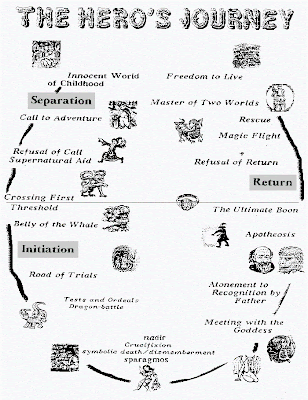 ...complicated.
Recently though I was Called to Adventure when a friend referred me to some articles written by Dan Harmon, the creator of the periodically outstanding show Community. I encourage you to read them yourself, if this stuff interests you, but basically his version of the Hero's Journey goes like this:
 Okay, that I can understand.
After reading his stuff, I feel like I have a better handle on this whole "monomyth" idea, so here's my interpretation of three well-known films using Dan's model. I chose these specifically as wildly different genres, and we can nitpick whether or not I applied the model correctly, but hopefully you'll agree that these films very much share the same basic structure:

If we go back to Campbell's work, there are many further parallels. Here are a few (by my own unofficial interpretations):
Refusal of the Call:
-Luke initially tells Obi Wan that he can't leave the farm (but then he finds it burnt to the ground along with his aunt and uncle).
-Dorothy is frightened about meeting the Wizard (although in her case this is after "crossing the threshold").
-Leo doesn't want any part of the scheme until Max convinces him that his drab existence is really no better than prison. (Max and Leo are sort of two opposing halves of a single hero.)
Tests, Allies, Enemies (this is Vogler's phrase. Campbell call's this stage "Road of Trials." Dan Harmon calls it "Search.")
In the first half of their adventure in the "special world," each of our heroes meets a collection of bizarre characters, as well as someone who will menace them later. At some point their resolve is also tested.
Atonement with the Father (aka "step 6: Take"):
-Luke sees Darth Vader, though he doesn't know [it was his sled].
-Dorothy forgives the Wizard and begs him to bring her home to Kansas in his balloon.
-Max and Leo are menaced by Franz Liebkind who is their play's "father."
George Lucas has in fact acknowledged being inspired by Joseph Campbell's work, but the truth is these primordial elements can be found in nearly everything you would call a story, from ancient myths to radio plays, videogames and sandwich commercials.
For more on story structure, listen to Jack Black in a wizard suit (by which I mean he's wearing a wizard suit, but you're welcome to wear one too, I guess):
Well anyway, he's an academic who wrote a rather influential book called The Hero with a Thousand Faces which basically describes the template found in stories since ancient times. And yes "template" is singular.
I always found it a fascinating notion that there was this underlying structure fundamental to storytelling, and Hollywood has certainly taken notice, but I was never quite able to wrap my head around Campbell's ideas. His map is a little...

Recently though I was Called to Adventure when a friend referred me to some articles written by Dan Harmon, the creator of the periodically outstanding show Community. I encourage you to read them yourself, if this stuff interests you, but basically his version of the Hero's Journey goes like this:
- . A character is in a zone of comfort,
- . But they want something.
- . They enter an unfamiliar situation,
- . Adapt to it,
- . Get what they wanted,
- . Pay a heavy price for it,
- . Then return to their familiar situation,
- . Having changed.

After reading his stuff, I feel like I have a better handle on this whole "monomyth" idea, so here's my interpretation of three well-known films using Dan's model. I chose these specifically as wildly different genres, and we can nitpick whether or not I applied the model correctly, but hopefully you'll agree that these films very much share the same basic structure:
Refusal of the Call:
-Luke initially tells Obi Wan that he can't leave the farm (but then he finds it burnt to the ground along with his aunt and uncle).
-Dorothy is frightened about meeting the Wizard (although in her case this is after "crossing the threshold").
-Leo doesn't want any part of the scheme until Max convinces him that his drab existence is really no better than prison. (Max and Leo are sort of two opposing halves of a single hero.)
Tests, Allies, Enemies (this is Vogler's phrase. Campbell call's this stage "Road of Trials." Dan Harmon calls it "Search.")
In the first half of their adventure in the "special world," each of our heroes meets a collection of bizarre characters, as well as someone who will menace them later. At some point their resolve is also tested.
Atonement with the Father (aka "step 6: Take"):
-Luke sees Darth Vader, though he doesn't know [it was his sled].
-Dorothy forgives the Wizard and begs him to bring her home to Kansas in his balloon.
-Max and Leo are menaced by Franz Liebkind who is their play's "father."
George Lucas has in fact acknowledged being inspired by Joseph Campbell's work, but the truth is these primordial elements can be found in nearly everything you would call a story, from ancient myths to radio plays, videogames and sandwich commercials.
For more on story structure, listen to Jack Black in a wizard suit (by which I mean he's wearing a wizard suit, but you're welcome to wear one too, I guess):
Subscribe to:
Posts (Atom)