
Tuesday, February 12, 2013
The Resource Economy of Super Mario Bros.
It is my contention that virtually any game can be better understood by viewing it as a resource economy and determining what the resource conversions are. To illustrate this, I've drawn up a (perhaps not exhaustive) resource economy for the original Super Mario Bros. and labeled the less-obvious conversion methods.


Friday, February 8, 2013
Fan Film Fanfare: Super Mario Busters & History of the Soviet Union Arranged To The Melody Of Tetris
Videogame-related fan film production quality has become ridiculous lately (and I'm not even speaking of Freddie Wong).
Sunday, January 20, 2013
Tesla's Revenge Soundtrack
I am pleased to publicly announce my upcoming game Tesla's Revenge soon to be released on iPhone, iPad and iPod Touch! I'm proud to be the first indy title of Codito Development, makers of the iPhone versions of several illustrious boardgames including Tigris & Euphrates, Tikal, Ra and Puerto Rico.
Maybe "soon" is a strong word. I'm still in the thick of designing levels, and though most of the game is 'built,' we haven't even started beta testing yet, but in the meantime the game's soundtrack is now available on iTunes to tide you over, though it's cheaper if you get it from CD Baby.
(Description from CD Baby:)
Tesla's Revenge is a light, electrifying strategy/puzzle game for iPhone, iPad and iPod Touch from Codito Development. This recording is the high-quality versions of the music for a game that's flowing with potential. We're positive you won't be able to resist! (Amped up with four bonus tracks from the iPhone game ThreadBound)
I'm extremely pleased with how this soundtrack came out. Much of the credit must go to my friend Peter D'Amico who is a proper music and sound producer guy (he did my mom's CD with the Allegra string quartet among other collaborations with her) and who graciously offered to produce the music for Tesla's Revenge for royalties, foregoing the usual studio rate (which wouldn't have exactly fit the game's budget, by a few zeroes). I wrote the songs, he found the noises, effects and professional mastering, and together we created something I'm rather proud of.
The game itself is shaking up nicely too. You can read (and see) more about it in our first press release over at boardgamegeek.com.
Maybe "soon" is a strong word. I'm still in the thick of designing levels, and though most of the game is 'built,' we haven't even started beta testing yet, but in the meantime the game's soundtrack is now available on iTunes to tide you over, though it's cheaper if you get it from CD Baby.
(Description from CD Baby:)
Tesla's Revenge is a light, electrifying strategy/puzzle game for iPhone, iPad and iPod Touch from Codito Development. This recording is the high-quality versions of the music for a game that's flowing with potential. We're positive you won't be able to resist! (Amped up with four bonus tracks from the iPhone game ThreadBound)
I'm extremely pleased with how this soundtrack came out. Much of the credit must go to my friend Peter D'Amico who is a proper music and sound producer guy (he did my mom's CD with the Allegra string quartet among other collaborations with her) and who graciously offered to produce the music for Tesla's Revenge for royalties, foregoing the usual studio rate (which wouldn't have exactly fit the game's budget, by a few zeroes). I wrote the songs, he found the noises, effects and professional mastering, and together we created something I'm rather proud of.
The game itself is shaking up nicely too. You can read (and see) more about it in our first press release over at boardgamegeek.com.
Friday, January 18, 2013
Implicitly Explicit Goals
Over the years I've come across numerous opinions that games like Sim City, The Sims, and most recently Minecraft, are not actually "games" because they do not have a goal. I would like to posit that not only is this position wrong, it belies a fundamental misunderstanding of how games work.
Or, if Minecraft's not really a game, then neither is World of Warcraft.
The misunderstanding comes from a belief that gameplay dynamics are more fundamentally defined by a game's explicit goals than they really are. If I drop you in the middle of a beat-em-up, you're going to start punching people not because you want to save your virtual girlfriend, not because you want a high score, not even necessarily because you don't want to die — In fact you might have no knowledge of those aspects of the game — No, your natural approach to gameplay is going to be to punch people because every aspect of the mechanics is centered around the act of you punching people. The action button makes your character punch, all the other people seem to want to punch you, there's a satisfying 'thwack' when your punches connect and an even more satisfying 'uaagh!' when they dramatically collapse and disappear after being punched by you enough times, and manipulating distance and time to land that finisher is a tantalizing mix of frustration and satisfaction. This is where the "game" resides because this is where the fun resides, not on a leaderboard or a credits screen, but in the mechanics of a virtual alleyway, a simulated ant farm, or an endless playground of voxels.
We have the concept of "goals" here in the idea of "bringing about a specific state of affairs." Maybe this state of affairs is defeating the other player, maybe the state of affairs is making all the thugs on the screen go 'uaagh!' and disappear, or maybe this state of affairs is mining enough diamond to craft diamond armor. The key point in all this is that this "state of affairs" does not definitionally have to be chosen for you by the game itself. In fact, at some basic level the game cannot choose your goal for you, because you must consent to play (or continue playing) the game in the first place. If I'm choosing what to play, and I decide to mine for diamonds in Minecraft rather than shoot Nazis in Medal of Honor, it hardly matters that I could have chosen to build a castle (or any number of other things) in Minecraft instead, whereas there weren't a whole lot of other things I could have chosen had I booted up Medal of Honor; these are all, at some level, goals I'm voluntarily taking up.
Now you could perhaps argue (and I have seen it argued) that Minecraft is in fact a suite of games including "the mining game," "the building game," "spleef," etc. and that Minecraft as a whole entity is not a game. I find this position more sensible, but also wrong. By this logic, Ocarina of Time is not a game, but rather a collection of games which include "the horseriding game," "the swordfighting game," "the orcarina playing game" and "the accidentally restarting explanatory text game."
But perhaps you take issue with the Bernard Suits definition of games and insist that games require an explicitly defined goal. In that case I present World of Warcraft. Oh sure, you can compete on various leaderboards and win internet fame in the same way that Minecraft allows you to build insane things like this and win internet fame, but WoW doesn't have a goal as such. There are at least four main reasons for playing, but there's no way to "win." Many have remarked that endgame play is merely a cycle of "get better loot to kill more stuff to get better loot," and at no point did an NPC even state that your mission was to get the best loot, just like no NPC in Minecraft stated that your mission was to portal into the Nether or build a giant pair of breasts on the side of a mountain or whatever your proclivity. Yet nobody argues that World of Warcraft, or others of its ilk, aren't real games. It's right there in the genre title: MMORPG ←case closed.
Or, if Minecraft's not really a game, then neither is World of Warcraft.
The misunderstanding comes from a belief that gameplay dynamics are more fundamentally defined by a game's explicit goals than they really are. If I drop you in the middle of a beat-em-up, you're going to start punching people not because you want to save your virtual girlfriend, not because you want a high score, not even necessarily because you don't want to die — In fact you might have no knowledge of those aspects of the game — No, your natural approach to gameplay is going to be to punch people because every aspect of the mechanics is centered around the act of you punching people. The action button makes your character punch, all the other people seem to want to punch you, there's a satisfying 'thwack' when your punches connect and an even more satisfying 'uaagh!' when they dramatically collapse and disappear after being punched by you enough times, and manipulating distance and time to land that finisher is a tantalizing mix of frustration and satisfaction. This is where the "game" resides because this is where the fun resides, not on a leaderboard or a credits screen, but in the mechanics of a virtual alleyway, a simulated ant farm, or an endless playground of voxels.
Now of course if I offer you an achievement that requires getting through my beat-em-up without any punching, only throwing enemies and barrels, this effects the game's dynamics a great deal, assuming (importantly) that you take up the challenge and decide to impose a rule on yourself that you won't punch. Interesting goals can change gameplay dynamics dramatically and potentially create interesting gameplay situations. Reiner Knizia has based many of his games primarily around an unusual scoring mechanism. But an interesting scoring system or achievement is not a requirement of games. You do not jump on the Goombas in Super Mario Bros. because of an interesting scoring system. It's also important to note that in our fictional generic beat-em-up, most of the achievements and scoring systems thought up off the top of one's head won't impel the player to stop punching people because that's what the game's about, irrespective of the "goal."
My favorite definition of "game" comes from Bernard Suits' underrated book The Grasshopper: Games, Life and Utopia. It reads as follows:
—————————————————————————————
My favorite definition of "game" comes from Bernard Suits' underrated book The Grasshopper: Games, Life and Utopia. It reads as follows:
—————————————————————————————
"To play a game is to engage in activity
directed toward bringing about a specific state of affairs, using
only means permitted by specific rules, where the means permitted by
the rules are more limited in scope than they would be in the absence
of the rules, and where the sole reason for accepting such limitation
is to make possible such activity."
—————————————————————————————
—————————————————————————————
We have the concept of "goals" here in the idea of "bringing about a specific state of affairs." Maybe this state of affairs is defeating the other player, maybe the state of affairs is making all the thugs on the screen go 'uaagh!' and disappear, or maybe this state of affairs is mining enough diamond to craft diamond armor. The key point in all this is that this "state of affairs" does not definitionally have to be chosen for you by the game itself. In fact, at some basic level the game cannot choose your goal for you, because you must consent to play (or continue playing) the game in the first place. If I'm choosing what to play, and I decide to mine for diamonds in Minecraft rather than shoot Nazis in Medal of Honor, it hardly matters that I could have chosen to build a castle (or any number of other things) in Minecraft instead, whereas there weren't a whole lot of other things I could have chosen had I booted up Medal of Honor; these are all, at some level, goals I'm voluntarily taking up.
Now you could perhaps argue (and I have seen it argued) that Minecraft is in fact a suite of games including "the mining game," "the building game," "spleef," etc. and that Minecraft as a whole entity is not a game. I find this position more sensible, but also wrong. By this logic, Ocarina of Time is not a game, but rather a collection of games which include "the horseriding game," "the swordfighting game," "the orcarina playing game" and "the accidentally restarting explanatory text game."
But perhaps you take issue with the Bernard Suits definition of games and insist that games require an explicitly defined goal. In that case I present World of Warcraft. Oh sure, you can compete on various leaderboards and win internet fame in the same way that Minecraft allows you to build insane things like this and win internet fame, but WoW doesn't have a goal as such. There are at least four main reasons for playing, but there's no way to "win." Many have remarked that endgame play is merely a cycle of "get better loot to kill more stuff to get better loot," and at no point did an NPC even state that your mission was to get the best loot, just like no NPC in Minecraft stated that your mission was to portal into the Nether or build a giant pair of breasts on the side of a mountain or whatever your proclivity. Yet nobody argues that World of Warcraft, or others of its ilk, aren't real games. It's right there in the genre title: MMORPG ←case closed.
Thursday, November 8, 2012
Scripted & Emergent Narrative
There are essentially two overarching
ways of delivering narrative in a game: scripted narrative and
emergent narrative. Scripted narrative includes all the stuff like
dialogue and cutscenes, and also scripted action sequences like many
of the setpieces in the Uncharted
series. Emergent narrative is the stuff that emerges directly
from the gameplay, like how you took out a truck in Far Cry 2
by ramming a boat into it, or that time your Sim missed his carpool
because he wouldn't stop throwing a tantrum about being bored, or
that time a Creeper killed you in Mincraft and made you drop a
bunch of diamonds in lava.
In reality you can't escape emergent
narrative in games. Even during the most tightly scripted setpiece,
there will be some room for player-driven narrative, whether you plan
for it or not. Maybe the player doesn't notice the boulder hurtling
towards them, and casually walks into it instead. I guess you could
make a visual novel, which may or may not count as a “game,” but
this is getting a little off track.
I was recently watching Mission
Impossible 4 and got to the totally awesome Dubai scene where Tom
Cruise climbs the exterior of the Burj Khalifa (which he apparently did for real because... Tom Cruise). In the film he's using special spy gloves
that adhere to the wall but, in the middle of his climb, one of them
malfunctions! Can our hero make it the rest of the way with only one
glove? (spoilers: yes)
**{I dearly wanted to find the clip,
but to no avail. Paramount evidently does not want me
advertising their film.}**
Anyway it got me thinking, since in my
view there are basically two approaches for doing something like this
in a game.
Approach #1: you script a sequence
where the player has to climb a tower, but then have their glove
malfunction (after they pass the halfway point or something).
Approach #2: you present the player the
goal of reaching the top of a tower and you give them a bunch of spy
equipment which has, among its characteristics, some probability of
malfunctioning.
Both of these approaches have various
advantages and drawbacks. The main advantage of the first approach is
that you can ensure that everything plays out roughly how you intend
it, every time. You set up all the dominoes and choose when and where
they fall. The main disadvantage of the scripted approach is that,
similar to the Hollywood movie, your player most likely understands
that this is a scripted event, and knows that if they play properly,
they will escape.
Approach #2 is likely harder to pull
off well, design-wise (if the equipment failure is too sudden and extreme, it could just be really annoying), but I wish to argue that it not only provides
a potentially richer experience, but is also less development-heavy in the long
run.
Take a similar situation in Minecraft.
Let's say you're low on health and are trying to dig your way to the
surface, but just before you make it out, your pickaxe breaks. Now
you realize you have to get back to your chest to pick up some wood
so that you can craft a new pickaxe, all while avoiding spiders and
deadly lava.
In another game this could work as a
scripted sequence, certainly. But wouldn't it feel like arbitrary
backtracking if the game told you your pickaxe broke and now you had
to go back and make another in order to move on?
There is tendency right now for game
developers to want to make things “cinematic.” If a AAA studio
were designing the above sequence, they might add some musical cues,
some shaky-cam effects, and maybe hire Ron Perlman to go “Just my
luck!” And it might be totally awesome.
But Notch didn't have the budget to
hire Ron Perlman, so instead he built a world with some voxels and
some basic ground rules, and he figured out which ground rules made
that world interesting to inhabit. Notch may or may not have intended
the above scenario, and it might never happen to you, but then there
are a million other scenarios that just might.
Scripted sequences can be a powerful tool, but at the end of the day, what you tell your friends about are those moments when you took out like four guys with a single sniper bullet, or when you flew off your motorbike and landed in a kiddy pool, or when your spy glove gave out but you still managed to reach the top.
I'm not arguing that all games should
be “sandbox games,” whatever that term means exactly. I think there is
lots of happy middle-ground between experiences entirely crafted by
the designer, and experiences entirely invented by the player. What I
am saying is that it's wrongheaded and inefficient to try and craft
every part of a gameplay experience because ultimately, no matter how
“cinematic” you make them, those moments will never be
significantly better than their film equivalents. Whereas when you
give up some control, and design in a way that allow for things to
happen organically, a game can be so much more than the sum of its
parts.
Saturday, October 6, 2012
The Storystudent's Journey
I imagine many people out there are familiar with Joseph Campbell? The Hero's Journey guy?
Well anyway, he's an academic who wrote a rather influential book called The Hero with a Thousand Faces which basically describes the template found in stories since ancient times. And yes "template" is singular.
I always found it a fascinating notion that there was this underlying structure fundamental to storytelling, and Hollywood has certainly taken notice, but I was never quite able to wrap my head around Campbell's ideas. His map is a little...
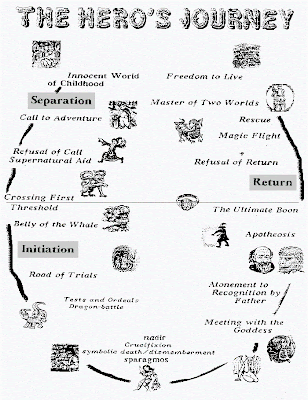 ...complicated.
Recently though I was Called to Adventure when a friend referred me to some articles written by Dan Harmon, the creator of the periodically outstanding show Community. I encourage you to read them yourself, if this stuff interests you, but basically his version of the Hero's Journey goes like this:
 Okay, that I can understand.
After reading his stuff, I feel like I have a better handle on this whole "monomyth" idea, so here's my interpretation of three well-known films using Dan's model. I chose these specifically as wildly different genres, and we can nitpick whether or not I applied the model correctly, but hopefully you'll agree that these films very much share the same basic structure:

If we go back to Campbell's work, there are many further parallels. Here are a few (by my own unofficial interpretations):
Refusal of the Call:
-Luke initially tells Obi Wan that he can't leave the farm (but then he finds it burnt to the ground along with his aunt and uncle).
-Dorothy is frightened about meeting the Wizard (although in her case this is after "crossing the threshold").
-Leo doesn't want any part of the scheme until Max convinces him that his drab existence is really no better than prison. (Max and Leo are sort of two opposing halves of a single hero.)
Tests, Allies, Enemies (this is Vogler's phrase. Campbell call's this stage "Road of Trials." Dan Harmon calls it "Search.")
In the first half of their adventure in the "special world," each of our heroes meets a collection of bizarre characters, as well as someone who will menace them later. At some point their resolve is also tested.
Atonement with the Father (aka "step 6: Take"):
-Luke sees Darth Vader, though he doesn't know [it was his sled].
-Dorothy forgives the Wizard and begs him to bring her home to Kansas in his balloon.
-Max and Leo are menaced by Franz Liebkind who is their play's "father."
George Lucas has in fact acknowledged being inspired by Joseph Campbell's work, but the truth is these primordial elements can be found in nearly everything you would call a story, from ancient myths to radio plays, videogames and sandwich commercials.
For more on story structure, listen to Jack Black in a wizard suit (by which I mean he's wearing a wizard suit, but you're welcome to wear one too, I guess):
Well anyway, he's an academic who wrote a rather influential book called The Hero with a Thousand Faces which basically describes the template found in stories since ancient times. And yes "template" is singular.
I always found it a fascinating notion that there was this underlying structure fundamental to storytelling, and Hollywood has certainly taken notice, but I was never quite able to wrap my head around Campbell's ideas. His map is a little...

Recently though I was Called to Adventure when a friend referred me to some articles written by Dan Harmon, the creator of the periodically outstanding show Community. I encourage you to read them yourself, if this stuff interests you, but basically his version of the Hero's Journey goes like this:
- . A character is in a zone of comfort,
- . But they want something.
- . They enter an unfamiliar situation,
- . Adapt to it,
- . Get what they wanted,
- . Pay a heavy price for it,
- . Then return to their familiar situation,
- . Having changed.

After reading his stuff, I feel like I have a better handle on this whole "monomyth" idea, so here's my interpretation of three well-known films using Dan's model. I chose these specifically as wildly different genres, and we can nitpick whether or not I applied the model correctly, but hopefully you'll agree that these films very much share the same basic structure:
Refusal of the Call:
-Luke initially tells Obi Wan that he can't leave the farm (but then he finds it burnt to the ground along with his aunt and uncle).
-Dorothy is frightened about meeting the Wizard (although in her case this is after "crossing the threshold").
-Leo doesn't want any part of the scheme until Max convinces him that his drab existence is really no better than prison. (Max and Leo are sort of two opposing halves of a single hero.)
Tests, Allies, Enemies (this is Vogler's phrase. Campbell call's this stage "Road of Trials." Dan Harmon calls it "Search.")
In the first half of their adventure in the "special world," each of our heroes meets a collection of bizarre characters, as well as someone who will menace them later. At some point their resolve is also tested.
Atonement with the Father (aka "step 6: Take"):
-Luke sees Darth Vader, though he doesn't know [it was his sled].
-Dorothy forgives the Wizard and begs him to bring her home to Kansas in his balloon.
-Max and Leo are menaced by Franz Liebkind who is their play's "father."
George Lucas has in fact acknowledged being inspired by Joseph Campbell's work, but the truth is these primordial elements can be found in nearly everything you would call a story, from ancient myths to radio plays, videogames and sandwich commercials.
For more on story structure, listen to Jack Black in a wizard suit (by which I mean he's wearing a wizard suit, but you're welcome to wear one too, I guess):
Thursday, August 2, 2012
Saracen Night
When you go to bed after designing and
prototyping for 12 hours straight, you sometimes have weird dreams.
Last night I
dreamt of some sort of pen-and-paper roleplaying system in which one
of the available classes was “Saracen Knight.” This class had
various melee bonuses as well as an interesting drawback: whenever you ran
into a British citizen, you were required to pay them money as
reparations on behalf of India for the Sepoy rebellion.
Because nothing screams high fantasy and adventure more than ironically depressing references to European colonialism!!
Because nothing screams high fantasy and adventure more than ironically depressing references to European colonialism!!
Wednesday, July 4, 2012
CERN Scientists Discover Comic Sans!
Today, after years of research and experimentation, scientists at CERN made the remarkable discover that people on Twitter really hate Comic Sans.
They also found the Higgs Boson, a particle theorized half a century ago by the standard model as necessary for explaining the existence of mass in the universe blah blah the point is, font choice is important! I bet when Cowan and Reines published their discovery of the neutrino, they used something sensible like Helvetica!
They also found the Higgs Boson, a particle theorized half a century ago by the standard model as necessary for explaining the existence of mass in the universe blah blah the point is, font choice is important! I bet when Cowan and Reines published their discovery of the neutrino, they used something sensible like Helvetica!
Friday, June 8, 2012
Humble Bundle V
The current Humble Indie Bundle is absolutely phenomenal. You can pay whatever you want for four different games, but if you pay above the average (which is currently hovering around 8 bucks), you get eight(!) games, each of which I can personally vouch for as being either awesome or ridiculously awesome (except Lone Survivor, which I haven't played, but which looks awesome):
-Superbrothers: Sword & Sworcery EP
-LIMBO
-Amnesia: The Dark Descent
-Psychonauts
-Bastion
And recently added (cinching this as a better gaming deal than even Valve's legendary Orange Box):
-Lone Survivor
-Braid
-Super Meat Boy
You also get all the soundtracks. The Superbrothers soundtrack alone costs 8 bucks, and it's well worth that.
But less than a week remains! So do not dally, my friends, nor dilly. If you must wait, then let it be only to allow Bastion's narrator to massage your eardrums.
-Superbrothers: Sword & Sworcery EP
-LIMBO
-Amnesia: The Dark Descent
-Psychonauts
-Bastion
And recently added (cinching this as a better gaming deal than even Valve's legendary Orange Box):
-Lone Survivor
-Braid
-Super Meat Boy
You also get all the soundtracks. The Superbrothers soundtrack alone costs 8 bucks, and it's well worth that.
But less than a week remains! So do not dally, my friends, nor dilly. If you must wait, then let it be only to allow Bastion's narrator to massage your eardrums.
Tuesday, May 29, 2012
Cosmic Rebirth
Apparently Family Guy creator Seth McFarlane is bringing back Carl Sagan's show Cosmos. I know that sounds like a setup for a Family Guy gag, but it's set to be hosted by Neil deGrasse Tyson, certified badass, so count me in.

It's set to air on Fox, which means it will reach a large audience, but which also means it will have a glorious first season and then get cancelled.
I look forward to that glorious season.
Take it, autotuned Carl Sagan!
It's set to air on Fox, which means it will reach a large audience, but which also means it will have a glorious first season and then get cancelled.

I look forward to that glorious season.
Take it, autotuned Carl Sagan!
Subscribe to:
Posts (Atom)